
Maritime Medical Associates: Beyond equipment: why the first minutes matter more than the tools on board
From onboard reaction to risk-oriented decision-making
Rubrica di Maritime Medical Associates
Contributo a cura del Dott. Claudio Bencini

On board a superyacht, medical preparedness has long been associated with what can be seen, stored, and displayed. First aid kits, oxygen cylinders, automated defibrillators, emergency drugs and increasingly sophisticated medical equipment have become the visible markers of readiness. They are reassuring, concrete, measurable. They suggest control.
And yet, when a real medical event occurs on board, particularly one involving chest pain, sudden collapse, or an unexplained deterioration of a guest’s condition, that sense of control often dissolves within minutes. The tools are there, the crew is motivated, procedures are recalled — but the most important question remains unanswered:
How serious is this, right now?
In the first moments of an onboard medical event, the central problem is rarely the absence of equipment or goodwill. It is the lack of an objective framework within which to interpret what is unfolding. Without such a framework, decisions are made under emotional pressure, shaped by fear, responsibility, and uncertainty rather than by structured understanding.
Crews are trained to act quickly, and speed is rightly emphasized in basic medical training. But speed without context can be deceptive. In isolated maritime environments, acting fast does not automatically mean acting appropriately.
In practice, many onboard medical situations drift toward one of two extremes. In some cases, caution escalates into overreaction, triggering unnecessary emergency calls, costly course deviations, or evacuations that later prove to have been avoidable. In other cases, apparent stability leads to underreaction, with symptoms monitored for too long until a critical window has quietly closed.
Both outcomes share the same origin: decisions taken in the absence of early, objective information.
This is where a subtle but profound shift is beginning to take place in the superyacht sector. Increasingly, the conversation is moving away from the question of “what should we do immediately?” toward a more fundamental one: “what level of risk are we facing?”
This represents a genuine change of paradigm.
The first goal in an onboard medical event is not to establish a diagnosis. It is to classify risk. Risk classification allows panic to be distinguished from true urgency, intuition to be tempered by evidence, and reaction to be guided by proportionality rather than instinct.
Without this step, even well-intentioned decisions remain emotionally driven.
In land-based emergency medicine, early risk stratification is a cornerstone of clinical practice. In a maritime context, where isolation amplifies uncertainty and delays are unavoidable, its importance is even greater.
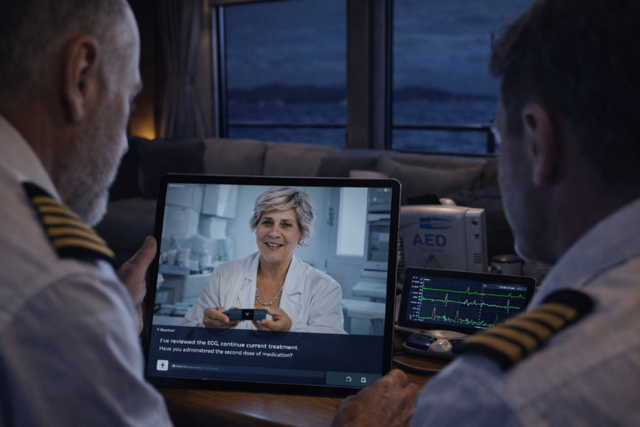
Two elements, if available immediately at symptom onset, can dramatically improve the quality of early decision-making: a recorded electrocardiogram and a rapid assessment of cardiac biomarkers. Their value lies not in providing definitive answers, but in framing the situation within a clear and objective temporal context.
Taken together, they do not tell the crew what the final diagnosis will be. They answer a more urgent question: does this situation fall into a low-risk category that can be safely observed, or into a high-risk category that requires immediate escalation?
This distinction, made early, is often far more consequential than a precise diagnosis reached hours later.
One of the most underestimated challenges in onboard medicine is the absence of a reliable timeline. Symptoms are frequently described retrospectively and imprecisely: pain that “started earlier”, discomfort that “came and went”, a condition that “seemed to improve”. Without objective data captured at the outset, time becomes elastic and unreliable.
Early ECG recordings and immediate biochemical markers anchor the event to a precise moment. They transform a subjective narrative into a documented clinical sequence. For specialists ashore, this temporal clarity is essential to interpret events correctly, even at a distance.
Ultimately, every onboard medical event converges on the same uncomfortable reality: the responsibility to decide rests with the captain. Whether to divert, to request evacuation, or to continue while monitoring is rarely a purely medical decision. It is an operational one, taken under uncertainty and time pressure.
A risk-oriented approach does not remove responsibility, but it reduces isolation. It replaces guesswork with structured information and transforms a solitary judgment into a guided process.
This evolution should not be mistaken for an attempt to medicalize the yacht or to turn crew members into healthcare professionals. On the contrary, it acknowledges a fundamental limitation: crews should not be asked to make complex medical decisions. They should be enabled to collect a small number of critical data points, immediately, and in a standardized way.
The sophistication lies not in the actions required on board, but in the method that gives those actions meaning.
As superyacht itineraries become longer, guests older, and cruising grounds more remote, the limits of a purely reactive medical model are becoming increasingly evident. The future of onboard medicine will not be defined by an ever-expanding inventory of equipment.
It will be defined by earlier clarity.
The first minutes are not about treatment. They are about understanding. And without objective information gathered immediately, every decision, no matter how fast, remains at its core an emotional one.
https://www.facebook.com/assistenzamedicapasseggeri
maritimemedicalassociates@gmail.com
Mobile: +39 335 335 291 – Via Marconi n° 16/B, 56043 Fauglia, PI
ISCRIVITI ALLA NEWSLETTER GRATUITA DI SUPER YACHT 24
SUPER YACHT 24 È ANCHE SU WHATSAPP: BASTA CLICCARE QUI PER ISCRIVERSI AL CANALE ED ESSERE SEMPRE AGGIORNATI