
OCEAN HEART GUARD™ Integrated informational document for the evaluation of the COCO™ course (Certified Operator Cardiac Offshore)
Bridging the critical gap between symptom onset and specialist guidance at sea
Rubrica di Maritime Medical Associates
Contributo a cura del Dott. Claudio Bencini

What you will find in this article:
- the real problem of chest pain onboard, beyond slogans
- the correct positioning of OHG™ with respect to CIRM and TMAS
- the practical meaning of the COCO™ course (Certified Operator Cardiac Offshore) and its stated limits
- some useful criteria to decide whether the pathway makes sense for your vessel
Executive summary
FILL IN THE OHG – CANDIDATE READINESS FORM
1. The real problem onboard
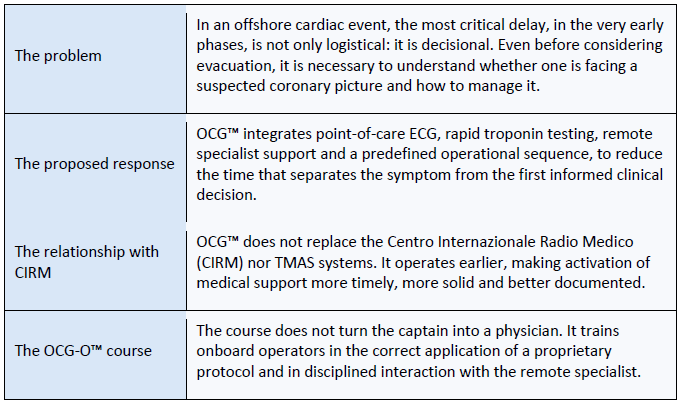
When a guest or an owner reports chest pain while at sea, the difficulty is not only suspecting a possible cardiac event. The real difficulty is deciding what to do in an environment that, by definition, is not an emergency department: there is no onboard doctor in most vessels, no laboratory, no hospital diagnostic chain, and almost never a truly operational cardiological language within the crew.
In this void, the captain and crew must manage a very delicate transition: transforming a reported symptom, often ambiguous, into a decision that may involve deviation from the route, activation of external services, significant economic impact and assumption of responsibility. The critical point is therefore not only the availability of advanced rescue resources, but what happens before, in the time during which the crew tries to understand whether the risk is serious, how serious it is and how urgently it must be treated.
This is the moment when everything is decided: not when the situation is already dramatically evident, but when it is still uncertain.
The real issue is not only “how to evacuate”, but “how early to understand that waiting is no longer an option”.
2. The spontaneous observation: “but CIRM already exists”
This objection is correct and must be addressed clearly. The Centro Internazionale Radio Medico (CIRM) is the Italian institutional reference for maritime medical assistance and its role is essential. Ignoring it or minimizing it would be not only incorrect, but counterproductive.
The point, however, is not the existence of CIRM; the point is the moment when CIRM comes into play. Institutional remote support is activated when someone onboard has already decided that the case deserves consultation; that is, when an initial interpretative step has already been taken. But precisely this step, in many cases, is the most fragile: symptoms are not always classic, hesitation, fear of raising an unnecessary alarm, fear of making an error by excess or by omission.
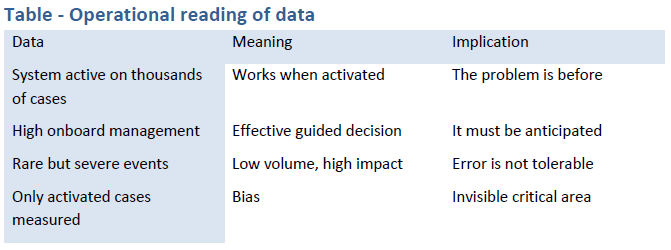
OCG™ is born precisely in this operational space. It does not present itself as an alternative to CIRM, nor as a duplicate of TMAS systems. It presents itself as an anterior and complementary layer: it helps the crew reach earlier the point at which a specialist call becomes justified, qualified and better documented. In other words, OCG™ does not replace the system; it helps make it work better, earlier and with more solid data.
3. What OCG™ is and what it is not
OCG™ must be understood for what it truly is: not a new medical device, not a brand that claims to transform existing products into a certified system simply because they have been assembled, and not a substitute for official assistance channels. OCG™ is a proprietary operational model. Its value does not lie in the mere presence of individual devices already available on the market, but in the way they are inserted into an ordered, trained and supervised decision sequence.
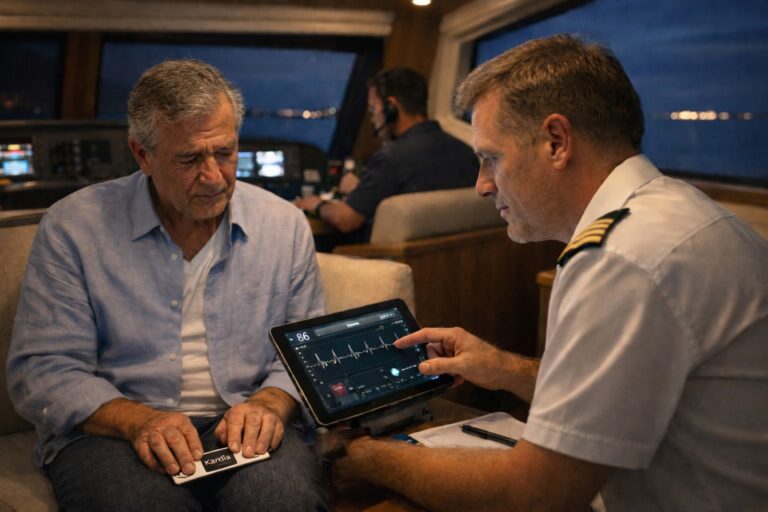
The protocol links four elements: structured collection of the clinical picture, point-of-care ECG, rapid troponin testing and remote specialist consultation. The novelty is not the separate existence of these tools; it is the fact that they are orchestrated as parts of a coherent pathway, designed for the most exposed phase of the offshore cardiac event.
It is equally important to clarify that OCG™ does not assign improper clinical autonomy to the crew. The system is built precisely to avoid improvisation: the trained operator collects data, correctly executes the sequence, transmits them and contributes to creating the conditions for a better specialist decision.
4. The clinical issue: delay is not only logistical
When reasoning about emergencies at sea, attention is often captured by evacuation: how long it takes to reach the coast, which means will be available, whether the weather permits intervention, how quickly the patient can reach hospital. All of this matters greatly, but it does not exhaust the problem.
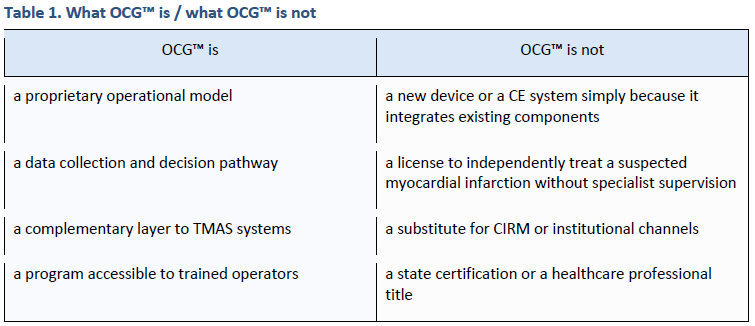
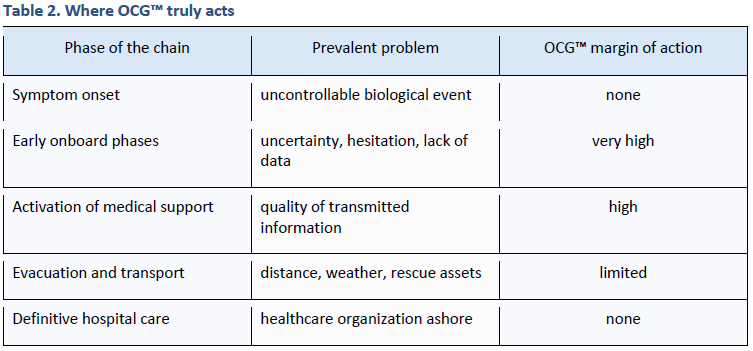
There is in fact a prior phase, less conspicuous but decisive: the time needed to recognize risk, collect objective elements and make the first sensible clinical decision. This interval can be called, in operational language, decisional delay. At sea, it is often the only part of the chain that can truly be compressed with appropriate tools and method, while logistical delay remains largely dependent on geography, weather and availability of rescue assets.
OCG™ focuses precisely on this modifiable portion of the clinical history. If the onboard decision remains vague and late, even the most efficient evacuation comes downstream of lost time. If, instead, the suspicion is qualified early, the logistical part of the response is built on a stronger and less random basis.
5. How the operational model works in practice
The value of a protocol is measured by its real applicability. OCG™ is not based on abstract steps, but on a concrete sequence that makes sense for the onboard environment. It starts from structured collection of the symptom and essential clinical data; proceeds with the point-of-care ECG; adds, when indicated, the rapid troponin test; transmits the data to the remote specialist; and then builds a decision that is not born from vague impressions but from more robust elements.
The strength of the sequence is not only technical. It is disciplinary. It reduces dispersion, limits improvisation, forces people to speak a common and documentable language. In this sense the protocol is also a governance tool: it organizes the way in which an event is observed, described and transferred into a decision.
For this reason OCG™ is closer to an operational architecture than to a simple set of devices. The tools alone are not enough: they need order, context and shared criteria in order to be truly useful.
6. Why the COCO™ course is the true access point
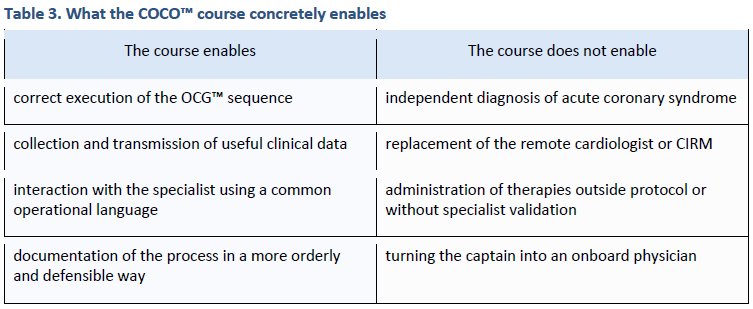
The COCO™ (Certified Operator Cardiac Offshore) program must not be understood as a decorative label. It is the access point to the system. The protocol, in fact, has value only if executed with the necessary discipline: knowing how to correctly position a device, acquire a useful trace, respect the sequence, not skip steps, not overinterpret the data, not transform specialist support into a confused delegation.
The course serves exactly this purpose: to create an onboard operator capable of applying the protocol without distorting it. It does not attribute a healthcare status, does not authorize replacing the physician and
does not change the regulatory framework of the professions. It enables, within the program, the correct use of a proprietary procedure that requires method, common language and traceability.
For this reason the course should be considered not as a commercial accessory, but as the safety foundation of the model. Without training, the presence of tools would risk being reduced to an accumulation of poorly governed potential; with training, the system becomes truly usable.
7. For whom the pathway makes sense
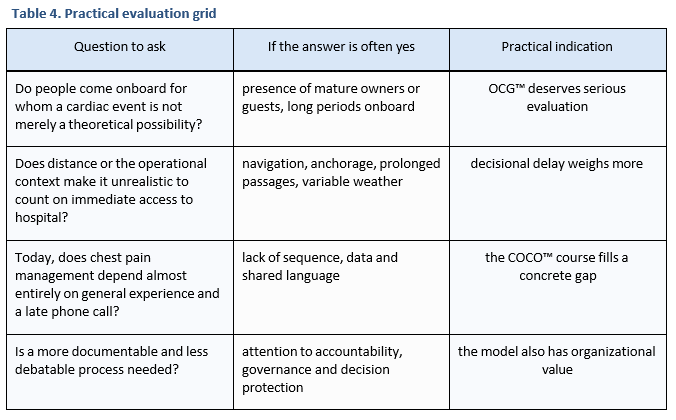
Not all vessels have the same risk profile, the same type of guests or the same operational style. For this reason, the most useful question is not whether OCG™ is “interesting” in the abstract, but whether it responds to a concrete and plausible risk for the vessel evaluating it.
The pathway makes particular sense when owners or guests with potentially more exposed age and clinical profiles come onboard; when navigation involves routes or anchorages in which time to access a hospital facility is not trivial; when the captain feels that current management of chest pain relies mainly on intuition, general experience and late calls to external support; and when, finally, a more documentable and less improvisational process is desired.
Conversely, perceived value may be lower in contexts where the vessel always operates very close to healthcare facilities, the guest profile is very controlled and risk governance is already covered by other internal arrangements. Even in these cases, however, the document remains useful because it forces the choice to be formulated explicitly.
8. Course program overview
Before deciding whether to go deeper, it is useful to take a further step: not so much asking whether the model is theoretically acceptable, but understanding what it means, in concrete terms, to apply it onboard.
Every protocol, in fact, truly exists only when it is executed. And between what is understood conceptually and what can be done in a real situation there is always a distance that must be bridged with method, common language and guided practice.
The COCO™ course is located exactly in this space: it does not add principles, but makes them operational.
Those who choose to proceed beyond the conference also need to understand, in concrete terms, what will be addressed in the course. A concise, non-promotional program is reported below, useful for positioning the level of the pathway.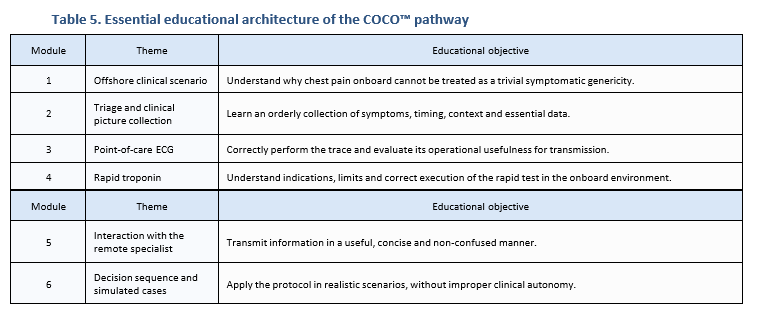
9. A decision to be made before the course
The correct question, at the end of this reading, is not whether OCG™ is suggestive or innovative in an abstract sense. The question is more sober and more serious: does it make sense, for your vessel, to address in a structured way the most fragile phase of the offshore cardiac event?
If the answer is yes, then the COCO™ course is the logical next step, because it constitutes disciplined access to the model. If the answer is no, the choice will remain the already familiar one: relying on goodwill, individual experience, the speed of external rescue and, ultimately, luck.
This document does not claim to close the debate. It does, however, ask that the problem be clarified as it is, and not as we would like it to be. Once this has been done, the decision whether to go deeper with the course becomes clearer and more mature.
In conclusion
OCG™ does not ask anyone to believe a promise. It asks them to observe an operational gap and to evaluate a possible response. Its core is not the slogan, but the sequence: first the symptom, then the data, then the specialist consultation, then the decision.
The moment when everything is decided, at sea, rarely coincides with obvious collapse. It almost always coincides with those preceding minutes in which someone onboard must understand whether a true cardiac emergency is beginning. That is where the COCO™ course proposes to intervene.
Terminological note
In this document, the term “certification” is used exclusively to indicate internal qualification within the COCO™ program, understood as verification of correct learning and of the ability to apply the OCG™ protocol according to the standards of the program.
This terminology does not imply, nor must it be interpreted as, state certification, a healthcare professional qualification, autonomous clinical authorization or regulatory validation of the devices used.
The use of the term is therefore to be understood exclusively in an internal, educational and operational sense.
FILL IN THE OHG – CANDIDATE READINESS FORM